
By Grace Stage Lighting | Engineering & Design Team
Foreword
If you've ever stood in the back of a concert hall and felt your jaw drop at the wall of light carving through haze, you already know what moving head lights do. What you might not know is how much engineering sits behind every sweep, color change, and prism-split burst. This guide pulls apart the whole machine — the optics, the mechanics, the control protocols, and the creative tools like gobos and prisms — so that whether you're specifying a rig for a 2,000-seat venue or picking your first fixture for a mobile DJ setup, you'll know exactly what you're looking at.
We'll also walk through Grace Stage Lighting's current moving head lineup, because talking about specs in the abstract only gets you so far. Real model numbers, real beam angles, real prism configurations — that's how you make an informed decision.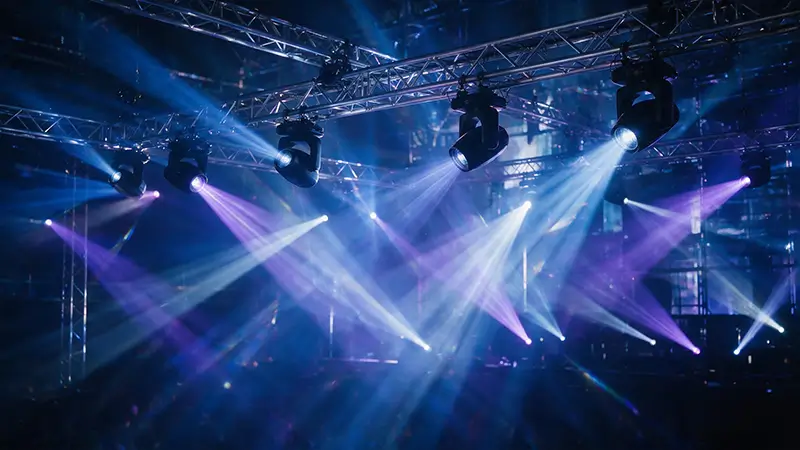
What Actually Makes a Moving Head "Intelligent"
A moving head light is not just a spotlight that rotates. It's a self-contained system that integrates three distinct engineering disciplines: optics, mechanical motion control, and electronic programming. Each of these has to work in lockstep, and a weakness in any one will drag down the entire fixture.
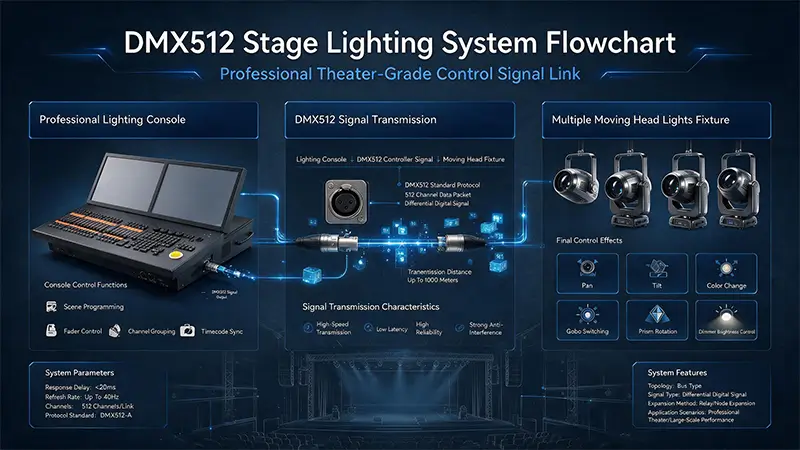
At its core, a moving head receives instructions from a lighting console — typically via DMX512 — and translates those digital commands into physical movement, color changes, gobo selection, prism rotation, dimming, and strobe effects. The fixture's onboard processors manage stepper motors that drive every moving component with precision. When you tell a moving head to pan 270 degrees and switch from a red wash to a gobo-split prism pattern, somewhere between eight and twenty motors are executing that choreography simultaneously.
That's the short version. To understand why some fixtures cost three times what others do — and why that difference matters on stage — we need to go system by system.
The Optical System: Where Light Is Born and Shaped
Everything starts with the light source. Two technologies dominate the market right now: discharge lamps ( Philips MSD, Yodn, Phoenix, and similar bulbs) and LED modules. Each has its camp of loyalists, and the trade-offs are real.
Discharge lamps — like the Yodn MSD 200R5 used in Grace Stage Lighting's Mini 230 or the Phoenix 380W bulb in the 380W Beam — produce an intensely focused, high-lumen beam with a color temperature that sits around 7,800–8,500K. They punch through haze like nothing else and give you that laser-like aerial beam effect that concert designers love. The downside is bulb life (roughly 2,000 hours for most discharge lamps) and the fact that they can't be re-struck instantly after shutoff — you have to wait for the lamp to cool before it'll fire again.
LED sources, like the 350W LED module in the 350W 17R CMY 3-in-1 or the 37×15W OSRAM LEDs in the GL-3715B zoom wash, flip those trade-offs. You get 50,000-hour lifespans, instant on/off, lower power draw, and lower heat. The trade-off historically was that LEDs couldn't match discharge lamps for raw beam intensity — but that gap has closed dramatically. Modern high-output LED moving heads produce beams that hold their own next to discharge fixtures in all but the largest stadium environments.
Beyond the light source itself, the optical system includes several components that shape what the audience ultimately sees:
Reflectors: Parabolic or textured reflectors behind the lamp collect and focus light. The reflector design directly affects beam uniformity — whether you get a clean, even field or hot spots and dark edges.
Color wheels: Most fixtures use a wheel with discrete color filters (typically 13 or 14 colors plus white/open). Higher-end models add CMY color mixing, which lets you dial in any color continuously rather than jumping between fixed positions.
Gobo wheels: These are patterned metal or glass disks that project shapes — geometric patterns, textures, logos — onto surfaces and through haze. A typical fixture carries one fixed gobo wheel and sometimes a second rotating wheel for animated effects.
Prism: An optical element (we'll dig into this extensively below) that splits a single beam into multiple copies, creating layered, kaleidoscopic effects.
Frost/atomization filter: Softens the beam edge, useful for wash transitions.
Focus lens group: Multiple lens elements that allow electronic linear focusing, letting you sharpen or soften the projected image from the console.
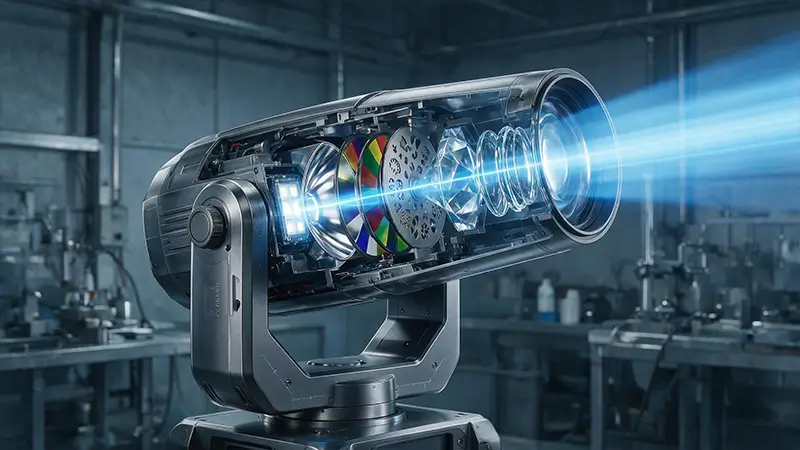
The optical path is sequential and matters: light exits the source, hits the reflector, passes through the color wheel, then the gobo wheel, then the prism (if engaged), through the focus lenses, and out the front aperture. Get any element misaligned and the whole chain suffers.
The Mechanical System: Precision in Motion
A moving head that can't move smoothly is worse than a fixed light. The mechanical system covers the physical chassis, pan and tilt mechanisms, material selection, and thermal management.
Pan and tilt range is one of the first specs buyers look at, and for good reason. The industry standard for professional fixtures is 540° horizontal (pan) and 270° vertical (tilt). Grace Stage Lighting's fixtures — from the Mini 230 up to the 380W 20R — all hit these numbers. What separates good from great is the motor quality. Three-phase stepper motors, like those used in the IP65 outdoor series, deliver faster movement, better holding torque, and significantly quieter operation than cheaper two-phase motors. When a fixture is running in a theater during a quiet scene, motor noise matters.
Materials vary by model and purpose. Indoor fixtures (IP20 rated) typically use a combination of aluminum die-cast chassis components, engineering plastics for housing, and steel for structural reinforcement. Outdoor fixtures step up to full die-cast bodies with high-strength nylon plastic, UV-resistant coatings, and sealed gaskets. Grace Stage Lighting's 350W/380W IP65 outdoor moving head, for instance, uses a die-cast body with anti-UV treatment and wind-direction drainage technology — it's designed to handle rain, dust, and direct sun without degrading.
Cooling is the silent killer in cheap fixtures. A poorly cooled moving head will experience color drift, premature component failure, and in worst cases, cracked color filters or dead motors. Quality fixtures use CFD (computational fluid dynamics) software to design airflow paths that maximize heat dissipation while keeping fan noise minimal. The IP65 outdoor series from Grace uses an intelligent temperature monitoring system that ramps fan speed based on real-time thermal data — quiet when it can be, aggressive when it needs to be.
Electrical and Control: The Brain
The control architecture of a modern moving head is built around DMX512 — the universal lighting protocol that's been the industry standard since 1990. Here's how it works at a practical level: a lighting console sends a continuous stream of data packets at 250 kbps (each bit takes 4 microseconds). Each packet contains up to 512 channels of 8-bit values (0–255). A moving head fixture occupies a certain number of those channels — anywhere from 11 to 31, depending on the fixture's feature set and the channel mode you select.
For example, Grace Stage Lighting's 380W Beam (GM-B380) operates in 16-channel mode: channel 1 controls pan, channel 2 controls tilt, channel 3 handles the color wheel, and so on through gobo selection, prism rotation, focus, dimming, and strobe. The 37×15W zoom wash (GL-3715B) offers three channel modes (11/19/31 channels), giving you the choice between simple control for smaller rigs or full-access control when you need individual LED pixel management.
Ballast type is the other electrical consideration. Discharge lamp fixtures use either inductive ballasts or electronic ballasts. Inductive ballasts are heavier but extremely stable and reliable — they're the workhorse choice for touring rigs. Electronic ballasts are lighter, which matters for installation weight limits, but they require more careful circuit design and have higher maintenance costs. Grace Stage Lighting uses electronic inductive ballasts in their 380W Beam, which offers a balance of stability and reasonable weight.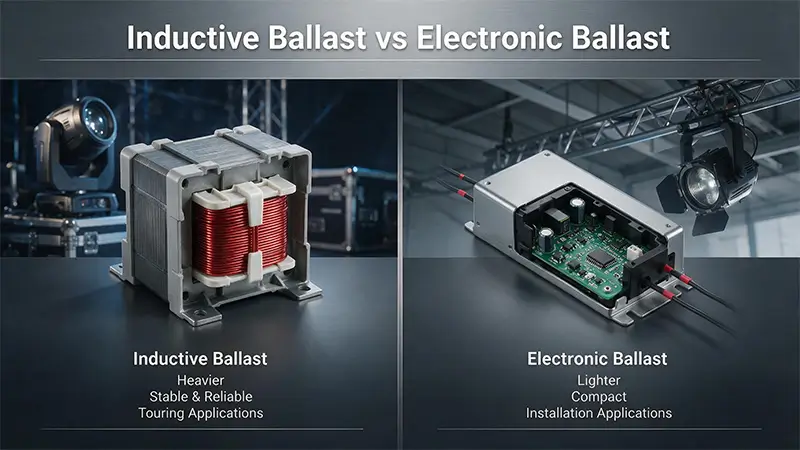
The Four Categories of Moving Head Lights
Not all moving heads do the same job. The industry sorts them into four functional categories, and knowing the difference is essential for specifying the right fixture for the right application.
(1.) Beam Moving Heads
Beam fixtures prioritize one thing: raw, piercing intensity in a narrow cone. Beam angles typically sit between 0° and 4°, producing a solid shaft of light that's visible in mid-air when haze is present. These are the lights you see cutting across a concert stage in synchronized sweeps.
Grace Stage Lighting's beam lineup spans from the compact Mini 230 (2.1° beam angle, 123,700 lux at 10 meters) up through the 295W 14R, the 380W Beam, and the 380W 20R with ring effect. The 380W Beam deserves particular attention — it uses a Phoenix 380W lamp producing 7,950 lumens at 8,500K, and its prism system (48-facet honeycomb + 12-facet, stackable and independently rotatable) is among the most versatile in its price class.
(2.) Spot / Profile Moving Heads
Spot fixtures (sometimes called profile fixtures) add gobo projection and framing to the equation. They're not just about shooting a beam — they're about projecting a shaped, focused image. A spot fixture will have at least one gobo wheel (often two — one fixed, one rotating), a focus system, and sometimes an iris or framing shutters for precise beam shaping.
The 350W 17R CMY 3-in-1 (GL-BSW350) sits in this category but actually crosses over into the next two as well. It features a 7-color + white color wheel, a rotating gobo wheel with 7 patterns + white, and a profile wheel that allows cutting custom shapes. With CMY color mixing and a 50,000-hour LED source, it's a fixture that can serve as beam, spot, and wash depending on how you configure it.
(3.)Wash Moving Heads
Wash fixtures trade beam intensity for coverage area. They produce soft, wide fields of color that fill space rather than cutting through it. Wash lights are what make a stage feel immersive — they paint the backdrop, the side walls, the floor, and the ceiling.
The GL-3715B zoom wash is Grace Stage Lighting's flagship LED wash fixture. It uses 37 OSRAM 15W LEDs with RGBW color mixing and a 10°–60° zoom range. At the wide end, you get broad, even coverage for architectural and stage wash. At the narrow end, you can still punch a defined beam for accent lighting. The 11/19/31-channel modes let you decide how much control granularity you need.
(4.) 3-in-1 (BSW) Moving Heads
Beam-Spot-Wash (BSW) fixtures do all three. They're the Swiss Army knife of the lighting world — not necessarily the best at any single function, but remarkably flexible. For rental houses and venues that need one fixture to handle multiple roles, a 3-in-1 is often the smartest investment.
Grace Stage Lighting offers the 280W 3-in-1 for DJ and event applications and the 350W 17R CMY 3-in-1 for professional installations. The latter is particularly notable for its CMY color mixing system, which gives you continuous color control instead of fixed color wheel positions — a feature that used to require fixtures costing twice as much.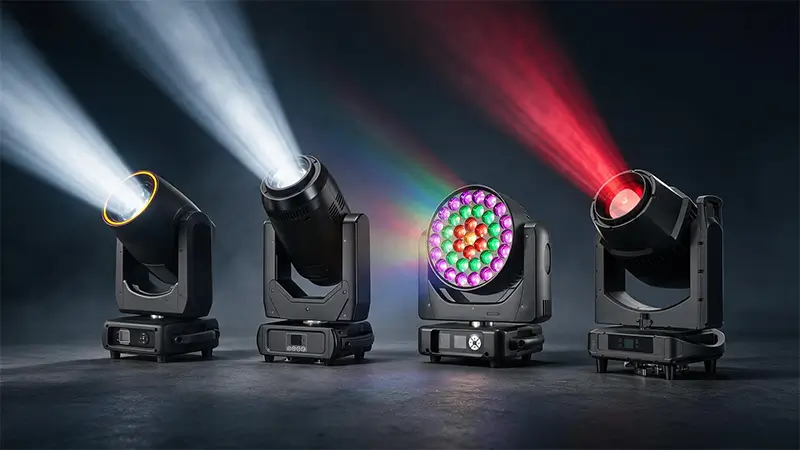
Prism Technology: The Science Behind the Spectacle
Of all the tools inside a moving head, the prism is the one that turns a good show into a great one. It's also the most misunderstood. So let's get into the actual optics.
How Prisms Work — The Physics
A prism is a transparent optical element with flat, polished surfaces that refracts light. When a beam of light enters a prism, it slows down (because glass has a higher refractive index than air), and this change in speed causes the light to bend. The amount of bending depends on the angle of incidence and the wavelength of the light — this is why a triangular prism splits white light into a rainbow (different colors bend by different amounts, a phenomenon called dispersion).
In moving head lights, though, we're not using prisms for color separation. We're using faceted prisms — disks with multiple flat facets arranged radially — to split a single beam into multiple parallel beams. Each facet acts like a small refractive surface, redirecting a portion of the incoming light at a slightly different angle. An 8-facet prism takes one beam and turns it into eight. A 24-facet prism turns it into twenty-four. The effect is instant multiplication.
The key insight is that the prism operates on light that has already been shaped by the gobo wheel. So if your gobo is projecting a star pattern, the prism doesn't just split a beam — it splits the entire star pattern, creating multiple stars that can rotate independently.
Prism Types and Their Visual Signatures
Not all prisms create the same look. Here's what to expect from each configuration:
Prism Type | Visual Effect | Best Use Case |
|---|---|---|
8-facet (single) | Eight clean, evenly spaced beams with generous gaps between them. Classic, structured look. | Concert beam effects, architectural accent lighting |
16-facet / 24-facet | Denser beam arrays. The stage fills with light more completely; gaps between beams shrink. More immersive. | Dance floors, nightclub environments,large-scale wash effects |
Dual-layer (e.g., 8+16) | Two prism layers stacked. Inner ring and outer ring display different patterns simultaneously. Creates a three-dimensional, layered feel. | Headlining acts, broadcast productions, moments that need a "wow" factor |
Honeycomb (48-facet) | Mimics a compound insect eye. Produces hundreds of micro-beams. When rotated, creates a kaleidoscope or starfield effect. | Peak moments in a show — intros, drops, finales |
Grace Stage Lighting's higher-end fixtures don't just include one prism — they stack multiple prisms that rotate independently. The 380W Beam, for example, pairs a 48-facet honeycomb prism with a 12-facet prism, and the two can be superimposed and rotated in opposite directions. The 295W 14R takes it further with an 8 + 16 + 24 (48 honeycomb) triple-prism system. The Mini 230 also features this three-layer prism arrangement (8+16+24), which is remarkable for a fixture at that size and price point.
The Gobo-Prism Pipeline: How They Work Together
Understanding the sequence matters. Inside the fixture, light follows a specific path, and the order of operations determines the final effect. Here's the three-stage process:
Stage 1 — Gobo Shaping: The raw beam from the lamp passes through the gobo wheel first. The gobo — whether it's a metal pattern cut with a laser, or a glass gobo with etched and colored designs — acts as a stencil. It blocks certain parts of the beam and lets the rest through, shaping the light into a specific pattern: a circle, a star, a texture, a company logo, a leaf pattern for a forest scene.
Stage 2 — Prism Multiplication: Now you have a single, shaped beam carrying a gobo pattern. This beam hits the prism. Each facet of the prism creates a copy of that gobo pattern at a slightly different angle. One star becomes eight stars. Or sixteen. Or forty-eight, if you're using the honeycomb prism.
Stage 3 — Dynamic Rotation: Here's where it gets genuinely stunning. The gobo wheel rotates in one direction while the prism rotates in the opposite direction. Now your multiple gobo copies aren't just sitting there — they're orbiting, intersecting, and creating complex, layered motion patterns that look almost organic. This is the effect that makes audiences pull out their phones.
Programming tip: the most impactful prism moments come from contrast. Don't run your prism all night. Engage it at a drop, a key change, or a visual climax. A sudden burst of kaleidoscopic beams after thirty seconds of clean, single-beam work hits far harder than continuous prism effect.
DMX512 Control: Making It All Dance
We touched on DMX earlier, but for anyone programming a rig, the details matter. DMX512 sends data in packets, each starting with a break signal (88 microseconds of low voltage), followed by a mark-after-break (8 microseconds of high voltage), then a start code, then up to 512 channels of 8-bit data. Each channel value ranges from 0 to 255.
In practice, here's what that means for a moving head: you assign each fixture a starting address (its "DMX address"), and the fixture reads channels starting from that address. A 16-channel fixture addressed at 001 occupies channels 1–16. The next fixture starts at 017. And so on down the line.
Modern fixtures from Grace Stage Lighting support multiple control modes beyond DMX: auto-run (built-in programs), master-slave (synced without a console), sound-activated (responds to music via internal microphone), and wireless DMX (WDMX) on select models. The 380W Beam, for instance, supports DMX512, WDMX, and self-propelled modes, giving you flexibility for everything from a fully programmed concert to a plug-and-play bar installation.
For outdoor fixtures, RDM (Remote Device Management) support is worth noting. RDM allows bi-directional communication — you can query fixture status, check temperatures, and adjust settings from the console without climbing a ladder. Grace Stage Lighting's IP65 outdoor series includes RDM support, which is a meaningful feature for productions where fixture access is difficult.
What to Look For When Choosing a Moving Head
Specification sheets can be overwhelming. Here's the framework we use when advising clients, distilled to the decisions that actually matter:
1. Light source and output. Match the fixture to your venue. A 100-capacity club doesn't need a 380W beam — you'll blind your audience. A 1,500-seat theater with a 20-meter throw distance will swallow a 230W fixture whole. As a rough guide: Mini 230 and 295W fixtures serve small to mid venues (bars, small clubs, mobile DJ). The 350W–380W range covers mid-to-large venues (concerts, churches, corporate events). The 600W outdoor model is for large outdoor spaces and architectural projects.
2. Prism system. If you're doing anything beyond basic beam work, prism quality matters. Look for independently rotatable, stackable prisms. A single 8-facet prism is fine for basic effects. Dual prisms with honeycomb options (like the 380W Beam's 48+12 configuration) give you dramatically more creative range.
3. Color system. Fixed color wheels (13 or 14 colors + white) are fine for most applications. If you need precise color matching for corporate events, broadcast, or theater, look for CMY mixing (available on the 350W 17R CMY 3-in-1).
4. Pan/tilt range and motor quality. 540°/270° is the standard. Pay attention to motor type — three-phase motors are quieter and faster. For installations near the audience, motor noise is a real consideration.
5. IP rating. IP20 for indoor-only. IP65 for anything that might see moisture, dust, or direct weather. Don't compromise here — an IP20 fixture outdoors will fail, and an IP65 fixture indoors works perfectly fine (it's just heavier).
6. Build quality and warranty. Die-cast aluminum bodies, quality fasteners, proper cable management. Grace Stage Lighting backs all fixtures with a one-year warranty and provides technical support from a team with 16+ years of field experience.2022 FIFA World Cup, Qatar
Egypt Pyramids Cultural Tourism Conference
Qatar Administrative Building Project
Uruguay National Television Station
Swiss Michelin-starred Restaurants (Dolder & Meating)
50+ Church Installations globally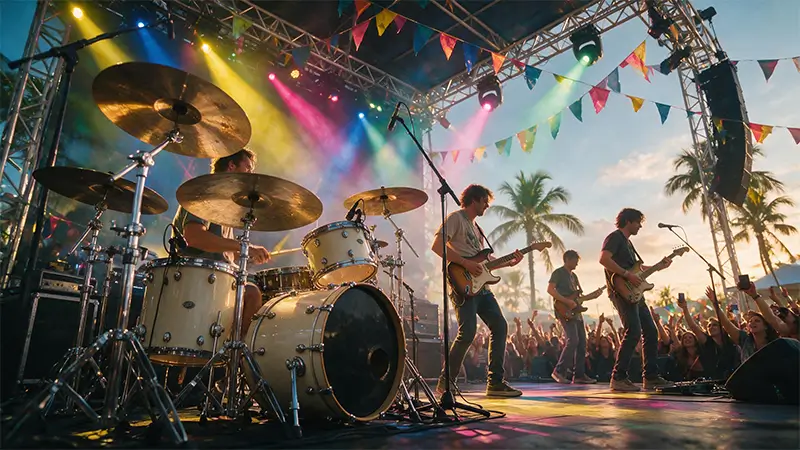
Real-World Applications
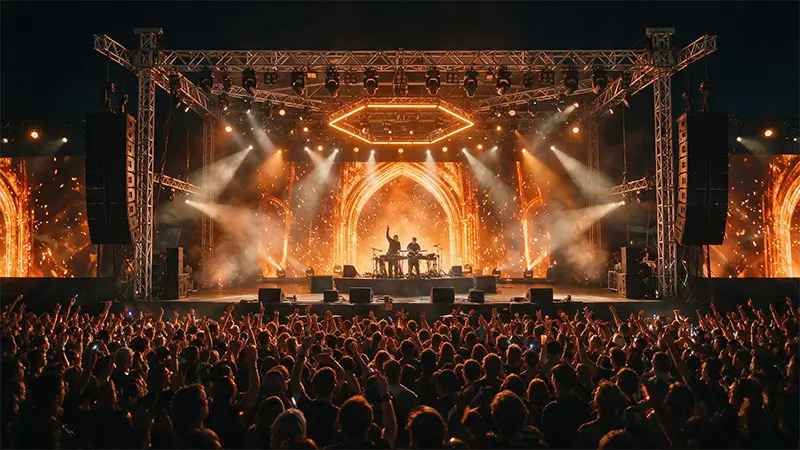
Concerts and tours: Beam fixtures are the backbone. The 380W Beam and 380W 20R with ring are built for this environment — high output, rugged construction, and prism systems that can handle complex programming. Touring rigs benefit from the 295W 14R as well, particularly for venues where weight is a concern (it comes in at 15.3 kg).
Bars and nightclubs: The Mini 230 is purpose-built for this market. At 60% the weight of the original 7R 230, with a three-layer prism (8+16+24) and 123,700 lux output, it delivers professional effects in a compact, affordable package. Pair it with a 37×15W zoom wash for color coverage and you've got a complete system.
Weddings and banquets: Wash fixtures carry the load here. The GL-3715B zoom wash produces soft, even color fields across a 10°–60° range — perfect for uplighting, stage washes, and ambient color shifts. Add a couple of beam fixtures for first-dance spotlight moments.
Theaters and broadcast studios: Spot fixtures with CMY mixing and gobo projection are essential. The 350W 17R CMY 3-in-1 fits here — its 50,000-hour LED source means minimal maintenance, and the CMY color system gives you the precise, repeatable color that broadcast demands.
Outdoor events and architectural lighting: The IP65 outdoor series (350W and 380W models) is designed for this world. Lightweight (about one-third the weight of traditional outdoor fixtures), fully weatherproof, and featuring RDM support for remote management. Grace Stage Lighting's outdoor moving heads have been deployed at the 2022 Qatar World Cup and Egypt Pyramids Cultural Tourism Conference — environments where failure isn't an option.
Maintenance: Keeping Your Rig Alive
Moving heads are precision instruments. Treat them well and they'll run for years. Neglect them and you'll be replacing color wheels and gobo motors before the first season is over.
Clean the optics regularly. Dust on gobo wheels, prism facets, and focus lenses degrades output quality and can cause uneven projection. Use compressed air and lint-free optical wipes. Never touch optical surfaces with bare fingers.
Check mechanical wear. Pan and tilt bearings, gobo wheel indexing pins, and prism rotation mechanisms all experience wear. If you notice positioning drift (the fixture doesn't return to the exact same spot when homed), it's time for maintenance. Grace Stage Lighting provides detailed troubleshooting support for common issues — positioning errors, color wheel jams, and reset failures can often be diagnosed and resolved remotely.
Manage thermal health. If a fixture's cooling system is underperforming, you'll see symptoms: automatic resets (the fixture detects overheating and re-homes itself), color drift (color temperature shifts as the lamp runs hot), or premature lamp failure. Keep intake and exhaust vents clear, and in outdoor fixtures, ensure drainage paths aren't blocked.
Update firmware. Manufacturers release firmware updates to improve motor response, add channel modes, or fix DMX compatibility issues. Keep your fixtures current — it's free performance.
Common Troubleshooting Quick Reference
Symptom | Likely Cause | Action |
|---|---|---|
Fixture won't power on | Blown fuse, disconnected power cable, failed internal power supply | Check fuse, verify power cable, test internal power output |
Lamp won't strike | End of lamp life, loose lamp base, ballast failure | Inspect lamp for clouding or blackening, reseat lamp, test ballast output |
Fixture resets mid-show | Overheating, unstable power supply, loose internal wiring | Check cooling system, verify power input stability, inspect internal connections |
Gobo or color wheel stuck/jittering | Deformed wheel, loose screws, failed motor, burned control channel | Inspect mechanical components, tighten,fasteners, test motor continuity |
Pan/tilt positioning drift | Dust on optical coupler, loose belt, motor step loss | Clean encoder, check belt tension, verify motor driver output |
Grace Stage Lighting's Moving Head Lineup at a Glance
Here's the current product range, organized by category, to help you match fixtures to your needs:
Outdoor / Waterproof (IP65)
600W Waterproof Moving Head — Maximum output for large outdoor stages and architectural projects
380W Waterproof Moving Head (GP-H380) — 480W total power, 13-color wheel + white, 17 fixed gobos with shake, rainbow wheel, dual prisms, 540°/270°, RDM support, 2.8" LCD
350W/380W Outdoor IP65 (GM-OB350W/380W) — Lightweight (1/3 traditional weight), 13+1 colors + rainbow + fog, 13 fixed patterns + white, 8-prism / 8+16-prism stackable, 16/20-channel DMX, three-phase XY motors
Indoor — Beam
7R 230W Moving Head — Classic beam fixture, proven reliability
Mini 230 (GL-MN230) — 60% weight of original 7R, three-layer prism (8+16+24), 123,700 lux @ 10m, 2.1° beam angle, 14 colors + white, electronic focus, ABS body, 11 kg
Mini 230W with Ring — Adds halo ring effect to the Mini 230 platform
295W 14R Beam (GM-B295) — Newfic lamp, 540°/270°, 13 colors + white, 9 gobos + 4 glass gobos, 8/8+16+24(48) triple prism, 16-channel, frost effect, 15.3 kg
14R Beam 295W with Ring — Ring-effect version of the 295W
380W Beam (GM-B380) — Phoenix 380W lamp, 7,950 lm, 8,500K, 48 honeycomb + 12-facet stackable dual prism, 14 colors + white + 6 colorful + rainbow, 10 fixed + 4 glass gobos, 16-channel, WDMX support, 12 kg
380W 20R Beam with Ring — 20R lamp with integrated ring effect, for nightclub and concert applications
300W LED Beam with Ring — LED300W module + 31 SMD, 7,950 lm, 14 colors + white, 14 fixed gobos + white, 48 honeycomb + 12-facet dual prism, 18-channel
Indoor — Spot / 3-in-1
350W 17R CMY 3-in-1 (GL-BSW350) — 350W LED, CMY color mixing, 7-color wheel + white, 7 rotating gobos + white, profile wheel for custom shapes, 50,000-hour LED life, PF > 0.9, 7,500K–8,000K
280W 3-in-1 — Beam/spot/wash in one fixture, ideal for DJ and event applications
Indoor — Wash
37×15W Zoom Wash (GL-3715B) — 37 OSRAM 15W LEDs, RGBW color mixing, 10°–60° zoom, DMX512/auto/master-slave/sound, 11/19/31-channel modes, 50,000-hour lifespan
Wrapping Up
Moving head lights are the most versatile tools in modern stage lighting. Understanding how they work — the optical chain from lamp through gobo to prism, the mechanical precision of pan and tilt, the DMX control architecture that makes it all programmable — is what separates someone who can operate a lighting console from someone who can design with light.
The fixtures matter, too. A well-engineered moving head with quality optics, proper thermal management, and flexible prism systems will outperform a cheaper unit that looks similar on paper. Grace Stage Lighting has spent 16 years refining this balance — professional-grade performance at factory-direct pricing, backed by a team that has installed lighting at World Cup venues, national television stations, and Michelin-starred restaurants across 90+ countries.
Whether you're specifying a full concert rig or picking up your first professional fixture, the principles are the same: understand your optics, match your output to your space, invest in prism flexibility, and never underestimate the value of good mechanical engineering. Get those right, and the light will do the rest.
Need help specifying the right moving head fixtures for your next project? Grace Stage Lighting's engineering team is available for consultation — from single-fixture selection to full venue design. Reach out through prostagelight.net and let's talk about what you're trying to light up.
Frequently Asked Questions
What are moving head lights and how do they work?
Moving head lights are intelligent stage lighting fixtures that combine an optical system, motorized pan and tilt movement, and digital control. They receive DMX signals from a lighting console to control beam direction, color, gobos, prism effects, focus, dimming, and other lighting functions for concerts, events, and architectural applications.
What is the difference between beam, spot, and wash moving head lights?
Beam moving head lights create narrow, powerful aerial effects for concerts and large stages. Spot moving heads are designed for gobo projection, focusing, and detailed lighting effects. Wash moving heads provide wide and smooth color coverage for stage backgrounds, events, and architectural lighting. BSW fixtures combine beam, spot, and wash functions in one unit.
How do prisms create special effects in moving head lights?
A prism inside a moving head light splits a single beam into multiple beams by using optical facets. Multi-facet prisms, such as 8-facet, 16-facet, 24-facet, and honeycomb prisms, create layered, rotating, and kaleidoscopic effects that enhance concert lighting and stage visual effects.
Why is DMX control important for moving head lighting systems?
DMX512 control allows lighting designers to program precise movements and effects across multiple fixtures. Through DMX channels, users can control pan, tilt, color mixing, gobos, prism rotation, focus, dimming, and strobe functions from a lighting console for professional productions.
How do I choose the right moving head lights for my stage or event?
Choosing the right moving head lights depends on venue size, lighting distance, application, and required effects. Beam fixtures are ideal for powerful aerial effects, spot fixtures suit projection and precision lighting, while wash fixtures provide wide coverage. For outdoor projects, IP65 waterproof moving heads are recommended for protection against weather conditions.